- The Governor General of Canada

The contents of this Register are intended for research purposes only. The heraldic emblems found in the Register may not be reproduced in any form or in any media without the written consent of the Canadian Heraldic Authority and/or the recipient.
Kennith James Robertson
Toronto, Ontario
Grant of Arms, Flag and Badges, with differences to Christopher David Robertson, Ethan Lucas Robertson and Emma Michaela Robertson
December 20, 2024
Vol. VIII, p. 335
[ previous page ]
Blazon
Arms
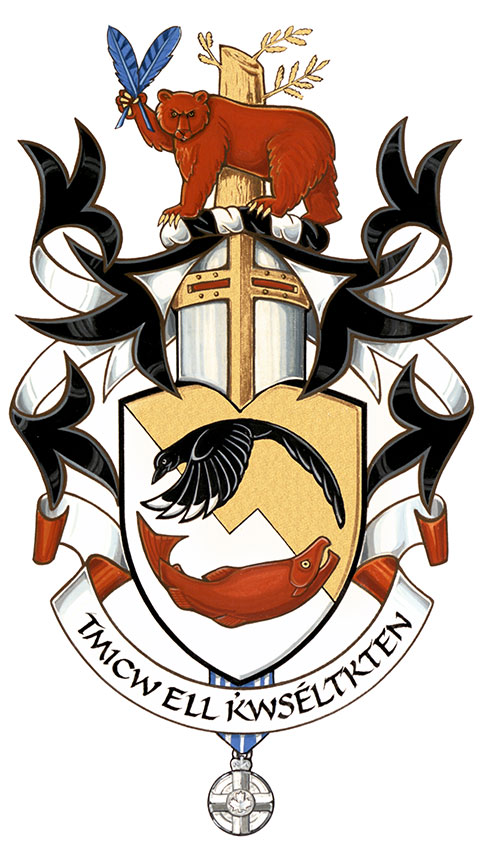
Per bend angled Or and Argent, in chief a magpie volant enarched Sable its wingtips Argent, in base a sockeye salmon embowed contourné Gules;
Crest
A bear passant guardant Gules holding two Steller’s jay feathers in saltire proper and in front of the stump of a western red cedar tree sprouting Or;
Motto
TMICW ELL K̓WSÉLTKTEN;
Symbolism
Arms
White, yellow, red and black represent the four sacred directions in Indigenous cultures. They highlight Mr. Robertson’s background and his involvement as chair of the Four Directions Autism support group. The angled line alludes to mountains, symbolizing the Rockies, where he grew up and has his family home. The magpie is his personal emblem. The sockeye salmon, an important food resource for both humans and wildlife, is found in the South Thompson River, which crosses the homeland of the Neskonlith Indian Band to which Mr. Robertson belongs. The two animals move in a circle, a symbol of unity and gathering, and a reminder of Mr. Robertson’s work in promoting inclusion and mental health.
Crest
The bear embodies the Cinnamon Bear clan, to which Mr. Robertson belongs, as well as his spirit name Skylux, meaning “bear cubs” in Secwepemctsin. The tree trunk alludes to timber, a natural resource found on the Neskonlith land. The sprouting sprigs and leaves symbolize the resilience of nature. The Steller’s jay is the official bird of British Columbia, Mr. Robertson’s native province. The number of feathers indicate that he is one of a pair of identical twins.
Motto
Meaning “Land and family” (“land” being understood here as “home”), this phrase is in Secwepemctsin, a Salishan language of British Columbia.