
- The Governor General of Canada

The contents of this Register are intended for research purposes only. The heraldic emblems found in the Register may not be reproduced in any form or in any media without the written consent of the Canadian Heraldic Authority and/or the recipient.
Owen Maxwell Rees
Ottawa, Ontario
Grant of Arms and Badge
May 15, 2025
Vol. VIII, p. 376
[ previous page ]
Blazon
Arms
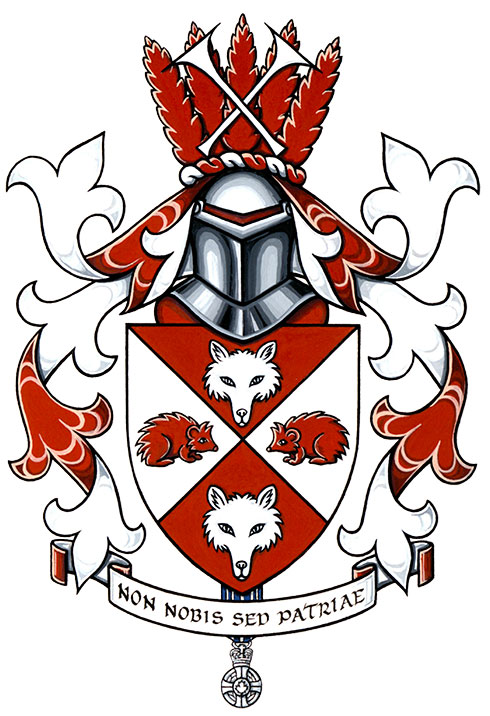
Per saltire Gules and Argent, in chief and in base a fox’s mask, in the flanks two hedgehogs respectant all counterchanged;
Crest
Two antique stethoscopes in saltire Argent in front of a panache of Russell lupine spires Gules;
Motto
NON NOBIS SED PATRIAE;
Symbolism
Arms
The foxes’ faces and the hedgehogs represent Mr. Rees’s work as a judge, as they refer to an aphorism by the Greek poet Archilochus that a fox knows many things, but a hedgehog knows one big thing. For Mr. Rees, a judge must embody the qualities of both a fox (grounded in the facts and specificity of a case) and a hedgehog (deriving general legal principles in a coherent way across the legal system). The X-shape division alludes to the saltire cross found in many Scottish Maxwell coats of arms, thus alluding to his mother’s family name, and in the arms of Queen’s University at Kingston, Ontario, where he studied law. The red and white colours are those associated with the Supreme Court of Canada, with which Mr. Rees has had a long association as a law clerk, as principal advisor to the Chief Justice and as the co-founder of the Supreme Court Advocacy Institute.
Crest
The stethoscope (depicted here in an archaic form) is a diagnostic tool alluding to the vocation of Mr. Rees’s wife Jocelyn Russell, a physician. It is a way of assessing the health of a patient by listening to the functioning of the heart; it also serves as a metaphor for Mr. Rees’s work as a judge in listening to evidence to assess a legal case. The Russell lupines allude to Dr. Russell’s family name, as well as being a flower that she cultivates.
Motto
This Latin phrase, meaning “Not for us but for our country,” demonstrates the importance of public service. It connects to the motto of the school Mr. Rees attended, Lower Canada College in Montréal, Non nobis solum, or “Not for us alone.” The use of Latin pays tribute to Mr. Rees’s late father-in-law, a scholar of Latin and Medieval French.