
- The Governor General of Canada

The contents of this Register are intended for research purposes only. The heraldic emblems found in the Register may not be reproduced in any form or in any media without the written consent of the Canadian Heraldic Authority and/or the recipient.

Suresh Kumar Agarwal
Toronto, Ontario
Grant of Arms, Flag and Badge with differences to Ranjan Kumar Agarwal and Rahool Parkash Agarwal
February 15, 2023
Vol. VIII, p. 145
Click on each image to enlarge. The blazon and symbolism for each element will accompany the enlarged image.
Blazon
Arms
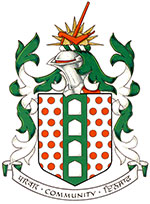
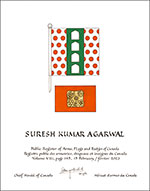
Argent semé of torteaux, on a pale Vert four inescutcheons reversed Argent;
Crest
A plough Gules in front of a demi-sun in splendour Or;
Motto
परिवार • COMMUNITY • ਧਨਸਕਾਫ;
Flag
A banner of the Arms;
Badge
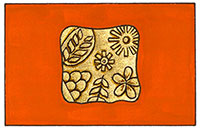
A billet fesswise Gules charged with a punch-marked coin Or;
Differenced Arms for Ranjan Kumar Agarwal, child of Suresh Kumar Agarwal
The Arms of Suresh Kumar Agarwal debruised of an antique crown Argent in place of the inescutcheon reversed in chief during his father’s lifetime;This individual will ultimately inherit the Arms;
Differenced Arms for Rahool Parkash Agarwal, child of Suresh Kumar Agarwal
The Arms of Suresh Kumar Agarwal debruised of a flame Argent in place of the inescutcheon reversed in chief;
Symbolism
Arms
The colours refer to those of the Indian flag. The discs, reminiscent of coins, allude to Mr. Agarwal’s lifelong career in business, as well as to his wife Anjali Agarwal’s career in banking. Evoking the Rotary Club emblem, they also represent Mr. Agarwal’s philanthropy and his wife’s volunteer work. The green band with the inverted shields alludes to the Agrasen ki Baoli in Delhi, India, an ancient stepwell reputedly built by the mythical King Agrasen from whom family lore says the Agarwals descend. The stepwell, a public structure providing access to water for the entire community, symbolizes Mr. Agarwal’s core belief in justice. The shields represent Mr. and Mrs. Agarwal and their two children.
Crest
The sun symbolizes India, since King Agrasen was a member of the Solar Dynasty, as well as British Columbia, where Mr. Agarwal and his wife first settled in Canada. The traditional Indian plough additionally represents the important agricultural dimensions of both the Punjab, the Indian state where Mr. and Mrs. Agarwal are from, and Alberta, where they spent a large portion of their adult lives.
Motto
These three words mean “Family, community, fairness” in Hindi, English and Punjabi.
Flag
The symbolism of this emblem is found in other element(s) of this record.
Badge
The rectangle alludes to a brick, and the square to a punch-marked coin. Together, they embody a legend about the generosity and sense of justice attributed to King Agrasen, whereby newcomers to his kingdom would be given one brick and one coin by all inhabitants to help them establish themselves. These themes are important to Mr. Agarwal’s family, as shown in his own philanthropic activities, his sons’ careers in the law and his daughters-in-law’s careers in medicine and education.
Differenced Arms for Ranjan Kumar Agarwal, child of Suresh Kumar Agarwal
The crown refers to his middle name, Kumar, one meaning of which is “prince” in Punjabi.
Differenced Arms for Rahool Parkash Agarwal, child of Suresh Kumar Agarwal
The flame refers to his middle name, Parkash, one meaning of which is “light” in Punjabi.
Background
Canada Gazette Information
The announcement of the Letters Patent was made on January 1, 1900, in Volume 0, page 0 of the Canada Gazette.
Artist Information
Creator(s)
Original concept of Alix Chartrand, Saguenay Herald, assisted by the heralds of the Canadian Heraldic Authority.
Painter
D. Robert Tunstall
Calligrapher
Kathy Feig
Recipient Information
Individual