- The Governor General of Canada

The contents of this Register are intended for research purposes only. The heraldic emblems found in the Register may not be reproduced in any form or in any media without the written consent of the Canadian Heraldic Authority and/or the recipient.
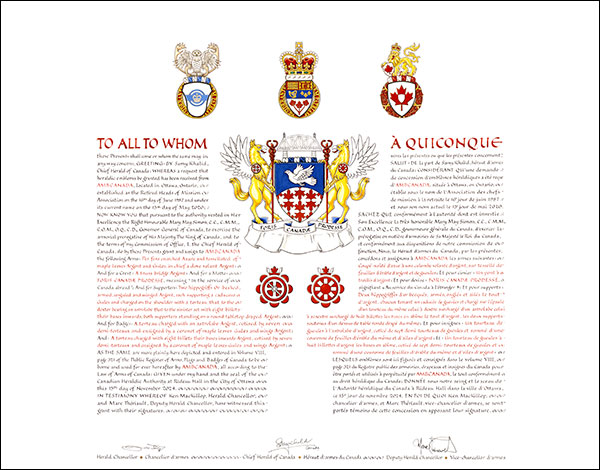
AMBCANADA
Ottawa, Ontario
Grant of Arms, Supporters and Badges
November 15, 2024
Vol. VIII, p. 321
Click on each image to enlarge. The blazon and symbolism for each element will accompany the enlarged image.
Blazon
Arms
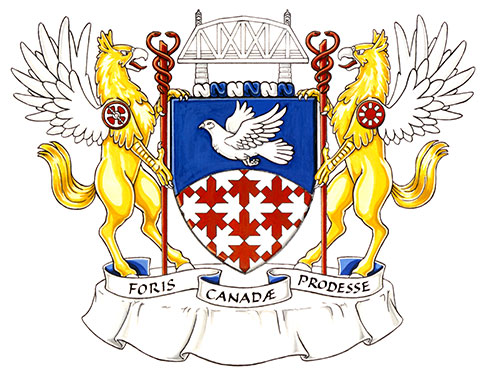
Per fess enarched Azure and tessellated of maple leaves Argent and Gules, in chief a dove volant Argent;
Crest
A truss bridge Argent;
Supporters
Two hippogriffs Or beaked, armed, unguled and winged Argent, each supporting a caduceus Gules and charged on the shoulder with a torteau, that to the dexter bearing an astrolabe that to the sinister set with eight billets their bases inwards, both supporters standing on a round tabletop draped Argent;
Motto
FORIS CANADÆ PRODESSE;
Badge
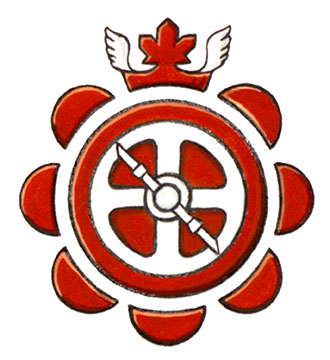
A torteau charged with an astrolabe Argent, cotised by seven demi-torteaux and ensigned by a coronet of maple leaves Gules and wings Argent;
Badge
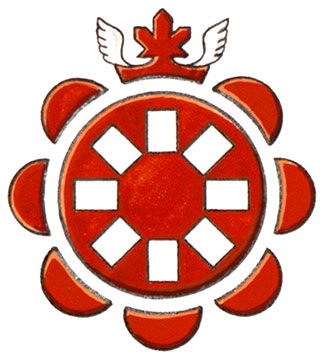
A torteau charged with eight billets their bases inwards Argent, cotised by seven demi-torteaux and ensigned by a coronet of maple leaves Gules and wings Argent;
Symbolism
Arms
Red and white are the colours of Canada, and blue symbolizes loyalty. The colours also represent how diplomats have travelled throughout history: by land (represented by red), by sea (blue) and by air or virtually (white). The curved line suggests the curvature of the globe. The maple leaves illustrate Canada’s international outreach through its foreign missions. The intermeshing pattern alludes to communication, which is at the core of foreign service work, and its intricate chequerboard design refers to the strategies of diplomacy. The dove embodies peace, the ultimate goal of diplomats.
Crest
The bridge represents the Minto Bridges, located near the headquarters of the department of Global Affairs in Ottawa. It embodies the connections that diplomats endeavour to build between Canada and other nations.
Supporters
The mythical hippogriff is the embodiment of freedom, alluded to by its combined characteristics of an eagle and a horse. Said to be able to fly to the moon, to have the eagle’s keen vision and to always protect its rider, the hippogriff thus also represents the diplomats who travel far, think with resolve, and advance Canadian interests. As the attribute of the Greek god Hermes, the caduceus is the mark of the traveller, messenger, and bringer of peace. The round table evokes meetings and discussions between people from different places. The astrolabe was used by explorers like Samuel de Champlain and illustrates how diplomats navigate international partnerships. The rectangles allude to documents such as letters of credence, treaties, briefing notes and diplomatic communications.
Motto
This Latin phrase means “In the service of Canada abroad.”
Badge
The disc and half discs allude to a round table around which diplomats are seated to talk. The crown and its maple leaves embody service to Canada, while its wings refer to the winged hat and shoes of Hermes, the mythical messenger and traveller. The symbolism of the astrolabe and rectangles repeats that of the elements on the supporters’ shoulders.
Badge
The symbolism of this emblem is found in other element(s) of this record.
Background
Canada Gazette Information
The announcement of the Letters Patent was made on January 1, 1900, in Volume 0, page 0 of the Canada Gazette.
Artist Information
Creator(s)
Original concept of Fabienne Fusade, Miramichi Herald, assisted by the heralds of the Canadian Heraldic Authority.
Painter
Melissa Aberin
Calligrapher
Kathy Feig
Recipient Information
Civil Institution