
- The Governor General of Canada

The contents of this Register are intended for research purposes only. The heraldic emblems found in the Register may not be reproduced in any form or in any media without the written consent of the Canadian Heraldic Authority and/or the recipient.
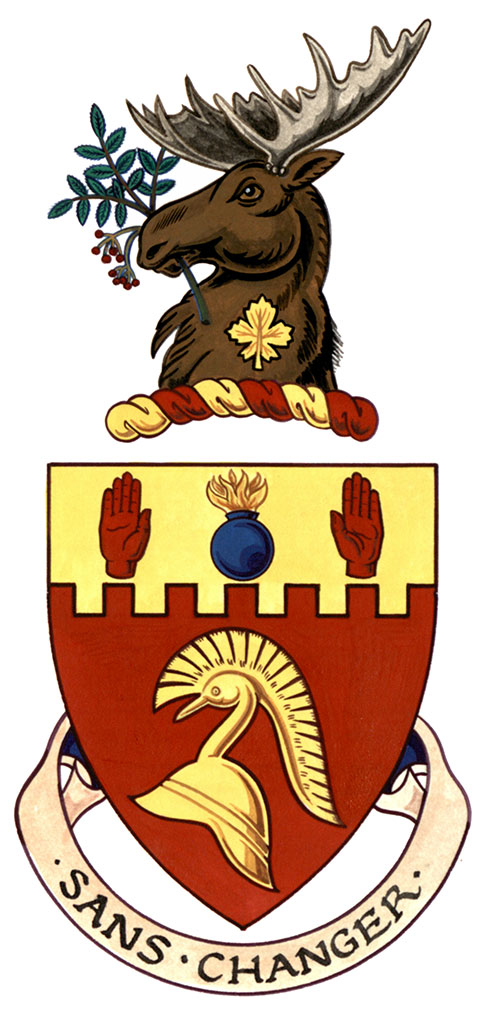
George Francis Gillman Stanley
Pittsburgh Township, Ontario
Registration of Arms
June 20, 2025
Vol. VIII, p. 393
Click on each image to enlarge. The blazon and symbolism for each element will accompany the enlarged image.
Blazon
Arms
Gules the helm of Athena Promachos, on a chief embattled Or a grenade Azure enflamed proper between a dexter and a sinister hand apaumé couped Gules;
Crest
A moose’s head proper charged on the neck with a maple leaf Or and holding in its mouth a branch of rowan leaved and fructed proper;
Motto
SANS CHANGER;
Symbolism
Arms
The helmet of Athena, which is based on a 5th-century BCE bronze statue called Athena Promachos, the latter word meaning “leading warrior,” symbolizes Dr. Stanley’s dual careers in the military and as a professor of history. Athena was the Greek goddess of wisdom and of warriors. The grenade, which features in the arms of the Royal Military College of Canada, alludes to Dr. Stanley’s two decades of teaching at that institution. The two hands reference the badge of the Scottish Clan Lamont, and thus Dr. Stanley’s ancestry.
Crest
The moose’s head is the regimental badge of The New Brunswick Rangers, the militia unit in which Dr. Stanley was commissioned in the late 1930s. The rowan branch alludes both to his Scottish ancestry and to the birthplace of his first ancestor to come to Canada, rowan trees also being called wigan trees in England and therefore evoking the town of Wigan in Lancashire. Finally, the maple leaf refers to his Canadian identity.
Motto
This French expression means “Without changing.” It is commonly used as a motto by individuals bearing the surname Stanley.
Background
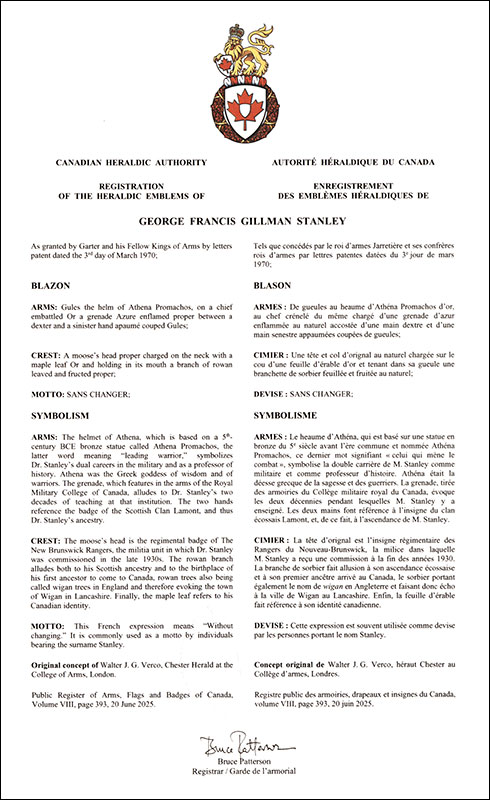
Canada Gazette Information
The announcement of the Letters Patent was made on January 1, 1900, in Volume 0, page 0 of the Canada Gazette.
Artist Information
Creator(s)
Original concept of the College of Arms, London.
Painter
Artist of the College of Arms, London / Artiste du Collège d’armes, Londres
Calligrapher
* Not applicable / Sans objet
Recipient Information
Individual
The recipient’s emblems were originally recorded at the College of Arms, London, England, 3 March 1970.